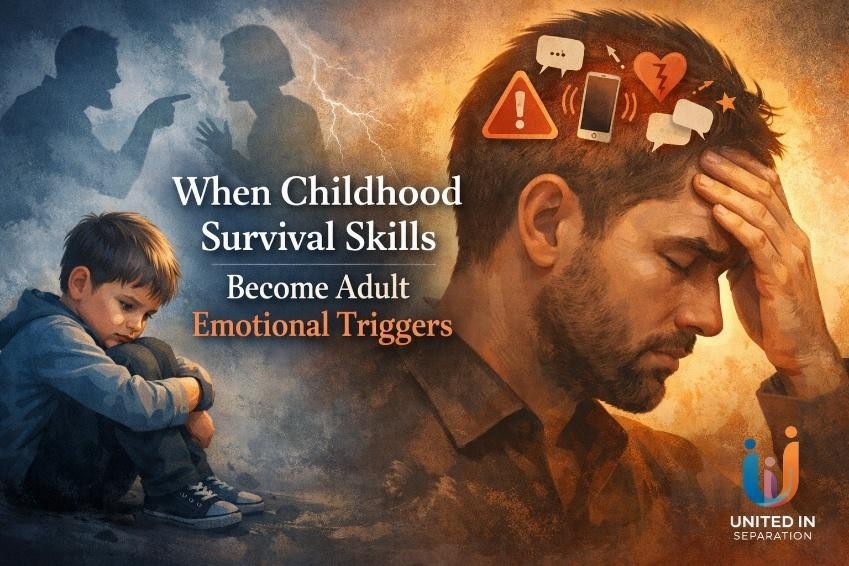
You’re not “too sensitive.”
You’re pattern-matching.
Most adult emotional triggers aren’t random.
They’re old protective strategies firing in new places.
That tight chest when someone’s tone shifts?
The panic when a message goes unanswered?
The anger when you feel misunderstood?
The shutdown when conflict shows up?
Those reactions often started long before your current relationship… or your current workplace.
Here’s what’s really happening:
• As a child, you learned what kept you safe.
• If love felt unpredictable, you became hyper-aware of mood changes.
• Now you read “danger” into a neutral face.
• If you were blamed or criticised a lot, you became preemptively defensive.
• Now feedback feels like an attack, even when it’s kind.
• If your feelings were dismissed, you learned to perform competence instead of
expressing needs.
• Now you struggle to ask for help until you’re already drowning.
• If conflict in the home felt explosive or icy, you learned to avoid or control it.
Now a simple disagreement can feel like abandonment.
A trigger isn’t a character flaw.
It’s a younger part of you saying:
“I remember what happened last time.”
The shift that changes everything:
Don’t ask, “What’s wrong with me?”
Ask, “What is this trying to protect?”
Then try this 10-second reset:
1. Name it: “This is my alarm system.”
2. Locate it: “I feel it in my throat/chest/stomach.”
3. Normalise it: “Of course, this shows up; this once helped me.”
4. Choose now: “What response fits today, not then?”
That’s emotional maturity: Not never being triggered… but recovering faster and responding with
choice.
Because your triggers don’t mean you’re broken. They mean you adapted.
And now… you get to update the strategy.
If this resonates, I’m curious: What’s a “small” moment that triggers a “big” reaction for
you?
Chris Kolade
United-In-Separation
Chris@unitedinseparation.com
www.unitedinseparation.com