
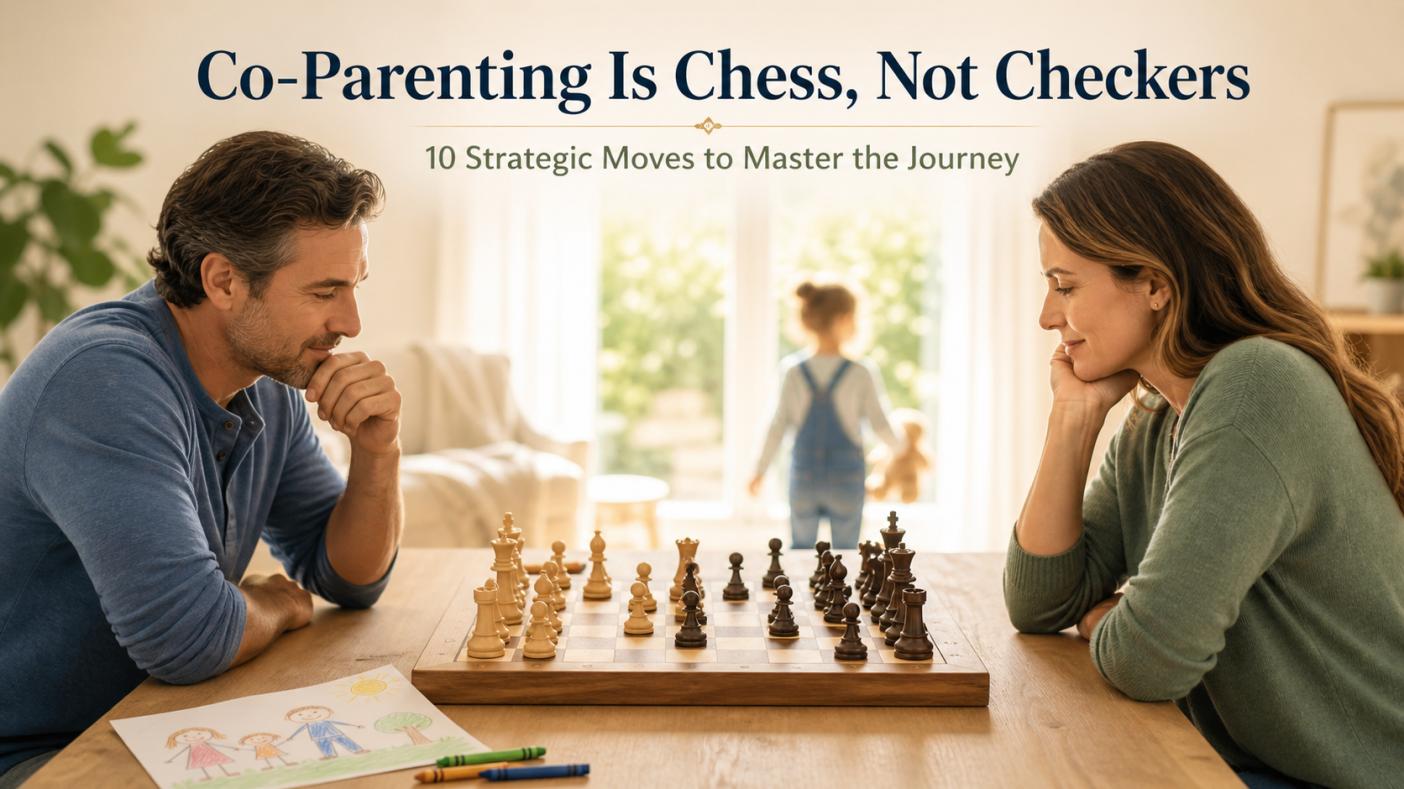
Co-parenting effectively is not about reacting to every move, defending every point, or trying to “win” the next argument.
It is about learning to think ahead.
In many ways, co-parenting is more like chess than checkers. Checkers is fast, reactive, and often focused on taking the next available piece. Chess requires patience, emotional discipline, foresight, positioning, and strategy.
And when children are involved, the goal is not to defeat the other parent.
The goal is to protect the child’s emotional world.
A chess master does not move impulsively. They pause, observe the board, anticipate consequences, and make decisions based on the bigger picture. Co-parenting requires the same wisdom.
Here are 10 ways to master your co-parenting journey by thinking like a chess master:
1. See the whole board, not just the next move
In co-parenting, it is easy to focus only on the latest message, disagreement, delay, tone, or accusation.
But chess masters do not make decisions based only on what is directly in front of them. They study the whole board.
In co-parenting, the “whole board” includes:
- your child’s emotional well-being
- school routines
- family relationships
- communication patterns
- past hurts
- future stability
- the child’s need to love both parents without guilt
Before you respond, ask yourself:
Am I reacting to this moment, or am I protecting the bigger picture?
2. Do not sacrifice your child as a pawn
In chess, pawns are often used to gain an advantage. In unhealthy co-parenting, children can sadly become emotional pawns without either parent fully realising it.
This happens when a child is used to carry messages, test loyalty, report information, reject the other parent, or comfort an adult’s pain.
A child should never feel responsible for managing adult conflict.
- Your child is not a messenger.
- Your child is not a witness.
- Your child is not a weapon.
- Your child is not a prize to be won.
A strong co-parent protects the child from the adult battlefield.
3. Think three moves ahead
Before sending that text, making that comment, refusing that request, or reacting to the other parent, pause and ask:
What might this create tomorrow, next week, or in my child’s memory years from now?
The emotional cost of impulsive co-parenting is often delayed. A message that feels satisfying today may create anxiety in your child tomorrow.
Thinking three moves ahead means asking:
- Will this reduce conflict or increase it?
- Will this make arrangements clearer or more difficult?
- Will my child feel safer because of this response?
- Will this help build trust, even slowly?
Maturity is not measured by how quickly you respond.
Sometimes, it is measured by what you choose not to say.
4. Control your position, not the whole board
One of the greatest mistakes in co-parenting is trying to control the other parent’s thoughts, emotions, tone, choices, or household.
You cannot control the whole board.
But you can control your position on it.
You can control:
- your tone
- your boundaries
- your consistency
- your honesty
- your emotional regulation
- your ability to keep the child at the centre
The more energy you spend trying to control the other parent, the less energy you have left to parent well.
Peace often begins when you stop trying to control everything and start managing yourself with wisdom.
5. Do not confuse silence with weakness
In chess, not every move is aggressive. Sometimes the strongest move is quiet positioning.
The same is true in co-parenting.
You do not have to respond to every provocation.
You do not have to correct every unfair comment.
You do not have to attend every argument you are invited to.
Silence, when used wisely, can be a strength.
But silence should not mean avoidance. It should mean emotional discipline.
A good co-parent knows the difference between:
- ignoring an important issue
- and refusing to fuel unnecessary conflict
Sometimes the most powerful response is calm, brief, respectful, and focused only on the child.
6. Protect the king: your child’s well-being
In chess, the king must be protected at all costs.
In co-parenting, the child’s well-being is the king.
Every decision should be measured against this question:
Does this protect my child’s peace, stability, identity, and sense of belonging?
Your child needs more than food, clothes, and school runs. They need emotional permission to love both sides of their family. They need adults who can manage discomfort without making the child carry it.
Winning the argument but damaging your child’s emotional security is not a victory.
It is a loss disguised as being right.
7. Learn the other parent’s patterns without becoming trapped by them
Chess masters study patterns. They notice repeated moves, weaknesses, habits, and risks.
In co-parenting, it is helpful to understand the other parent’s patterns, but it is dangerous to become obsessed with them.
Use that awareness wisely:
- not to attack
- not to diagnose
- not to blame
- but to plan better
If you know a certain conversation usually escalates, change the way it is handled. Keep messages brief. Use neutral language. Stick to arrangements.
Patterns become less powerful when you stop feeding them in the same old way.
8. Know when to defend and when to develop
In chess, a player who only defends eventually becomes trapped. But a player who attacks without thinking becomes exposed.
Co-parenting requires balance.
There will be moments when you must defend a boundary clearly. There will also be moments when you must develop the relationship for the sake of your child.
Defending sounds like:
“I want us to keep communication focused on the arrangements and what helps the children.”
Developing sounds like:
“I appreciate you confirming the details. That helps keep things clear.”
Healthy co-parenting is not about being soft. It is about being strategic, child-focused, and emotionally steady.
9. Play the long game
Your child may not understand everything now.
But over time, they will remember who made things easier, who made things heavier, and who gave them permission to love.
Co-parenting is a long game.
The goal is not just to survive this week’s disagreement. The goal is to build a pattern your child can trust.
Trust is not rebuilt through one grand gesture.
It is rebuilt through consistency.
10. Remember: checkmate is not the goal
In co-parenting, the goal is not to trap, defeat, or outmanoeuvre the other parent.
The goal is stability.
- A child who does not have to choose sides
- A child who can enjoy birthdays without anxiety
- A child who can speak freely about both parents
- A child who feels secure in both homes
The best co-parents are not the ones who win every battle.
They are the ones who stop turning parenting into a battlefield.
Final Reflection
Co-parenting like a chess master means slowing down, thinking ahead, protecting what matters most, and refusing to let conflict dictate every move.
You may not control the other parent’s behaviour, but you can choose your own next move.
So before you react, pause and ask yourself:
Is this a checkers move, or a chess move?
Am I trying to win the moment, or helping my child win in life?
Choose wisely.
Because in co-parenting, every move teaches your child something.
Chris Kolade
Sunday the 15th of March 2026
United-In-Separation
Chris@unitedinseparation.com
www.unitedinseparation.com